
Moving day catches people out more than they expect. You pack for weeks, label every box, and still find yourself rummaging through a mountain of taped-up cardboard at 10pm looking for your toothbrush. A solid moving day essentials list is not about packing everything — it is about knowing exactly what you need within the first 24 hours and keeping those items close at hand. This guide gives you a practical, prioritised checklist built around the one concept that changes everything: the First Night Survival Kit.
Table of Contents
- Key takeaways
- 1. The moving day essentials list: how to start right
- 2. Personal care and hygiene kit
- 3. Important documents and valuables
- 4. Basic tools and an emergency fix kit
- 5. Food, water, and coffee essentials
- 6. Bedding and comfort items
- 7. Children and pets comfort essentials
- 8. Comparison of essentials kits by priority
- 9. Situational recommendations and final walkthrough tips
- My honest take on moving day essentials
- How Themuscleandtruck makes moving day easier
- FAQ
Key takeaways
| Point | Details |
|---|---|
| Pack an “Open First” box | Include first-night items and keep it in your personal vehicle, not the moving truck. |
| Prioritise your first night | Set up beds, bathroom basics, and a coffee station before unpacking anything else. |
| Never pack essentials with movers | Items on the moving truck can be inaccessible for hours, causing unnecessary stress. |
| Conduct a move-in walkthrough | Document existing damage before unloading furniture to protect your tenancy deposit. |
| Personalise your kit | Adjust your list for children, pets, or medical needs to avoid last-minute gaps. |
1. The moving day essentials list: how to start right
Before you add a single item to your bag, you need a framework. The two strategies that work best are the No-Pack Zone and the **“Open First” box.
The No-Pack Zone is a designated corner of your home, set aside before the movers arrive. Anything placed there does not get touched by the moving team. It holds your overnight bag, important documents, and anything you will need within the first few hours at your new place.
The “Open First” box works alongside it. This is the one box that travels with you, not with the truck. Pack it last and load it into your car. It should hold everything you need for the first 24 to 48 hours: toilet paper, hand soap, phone chargers, a change of clothes, and any medications. These are the items that cause real problems if they end up buried under a sofa.
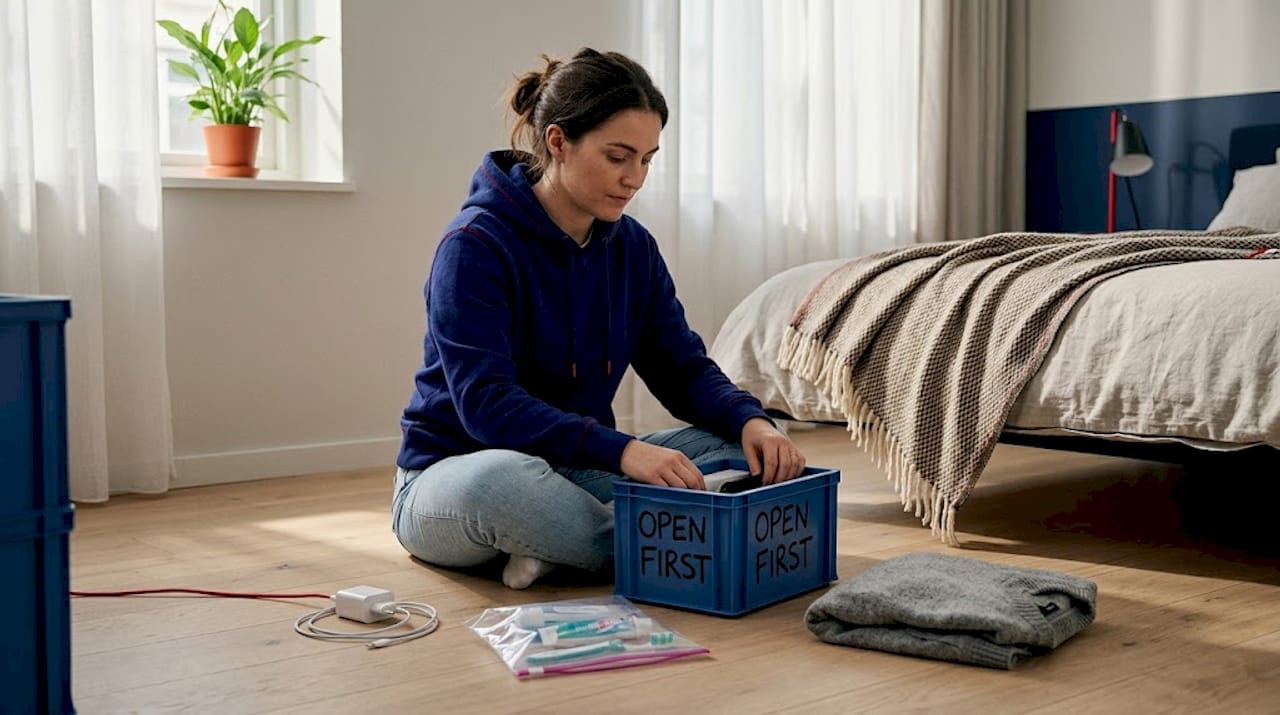
Organisation matters too. Labels and colour-coding systems take a little time upfront but save a great deal of stress when you are tired and trying to find the kettle at midnight.
Pro Tip: Write “OPEN FIRST” in large letters on the top and all four sides of your essentials box. It sounds obvious, but when ten boxes arrive in a new flat, you will be glad you did it.
A moving day preparation list built around these two systems gives you a clear head from the moment you arrive.
2. Personal care and hygiene kit
This category gets forgotten more than any other. People assume they will unpack the bathroom boxes quickly. They rarely do.
Your hygiene kit should include:
- Toothbrush and toothpaste
- Soap and a small towel
- Shampoo and conditioner (travel sizes work well)
- Deodorant
- Any daily prescription medications
- Sanitary products if needed
- Toilet paper (at least one full roll per person)
Pro Tip: Put medications in a clearly labelled ziplock bag and carry them on your person, not in a box. If the truck runs late or there is an access issue at the new property, you will not be left without them.
A good overnight essentials bag should include toiletries and medications to ease transition in the first 48 hours. This is especially true in Singapore, where humidity makes a quick shower at the end of moving day feel like a genuine necessity.
3. Important documents and valuables
This is non-negotiable. These items must never go onto the truck.
Keep the following in a dedicated folder or pouch that stays with you throughout the day:
- National identity card or passport
- Tenancy agreement or property documents
- Utility transfer confirmations
- Insurance documents
- Birth certificates and marriage certificate if relevant
- Bank cards and a small amount of cash
- Laptop or tablet (if you need access during the day)
Must-have items for moving always include documents and valuables, and that is because replacing them is expensive, slow, and stressful. Keep this pouch in the same bag as your personal hygiene kit.
4. Basic tools and an emergency fix kit
You will almost certainly need tools within the first few hours. A flat-pack bed frame needs reassembling. A curtain rail needs rehooking. A drawer handle comes loose in transit.
A compact tool kit for moving day should include:
- Screwdriver (both flathead and Phillips)
- Allen keys or a multi-tool
- Hammer
- Measuring tape
- A pack of cable ties
- Scissors or a box cutter
- Packing tape and a spare marker pen
This kit also lives in your personal vehicle, not on the truck. The first-night box strategy recommends keeping basic tools alongside hygiene and clothing items, and that is good advice. You want to be able to set up a bed and assemble a bathroom shelf before the evening is over.
5. Food, water, and coffee essentials
Moving is physical work. Even if you have hired a team to do the heavy lifting, you will be on your feet for most of the day. Hunger and dehydration make everything harder.
Pack the following in a small cooler bag or tote:
- Bottled water (at least 1.5 litres per person)
- Non-perishable snacks: granola bars, crackers, nuts, dried fruit
- Instant coffee or tea bags plus a travel mug
- A small pot or kettle if you can spare the space
- Paper plates, plastic cutlery, and napkins
Do not plan on cooking a proper meal on moving day. Order in that first night. What you need from this kit is enough fuel to get through the day without burning out before the truck is unloaded.
6. Bedding and comfort items
Setting up beds first to reduce stress is one of the most commonly cited pieces of moving day advice, and it holds up. A made bed at the end of moving day changes how the whole evening feels.
Pack a separate bag or bin liner clearly labelled “beds” containing:
- Fitted sheets and pillowcases for every bed in the house
- A light blanket or duvet per person
- Pillows
- A sleep mask and earplugs if you are a light sleeper (new environments are noisy)
Your comfort items bag should also include a fresh change of clothes for the next morning. You do not want to start day two searching for clean socks.
7. Children and pets comfort essentials
If you have children or pets, their needs go right to the top of your moving day preparation list.
For children, pack:
- A familiar soft toy or comfort item
- Colouring books, a small tablet, or quiet activities
- Their usual snacks and drinks
- Any nappies, wipes, or specialist products they use
- A change of clothes and pyjamas
For pets, prepare:
- Food and water bowls plus a day’s supply of food
- A familiar blanket or bed
- Their usual lead, harness, or carry case
- Any medications or supplements they take
- A copy of their vaccination records if you are moving to a new area
Pets and children feel the disruption of a move acutely. Familiar smells and objects go a long way toward keeping both calm during an otherwise chaotic day.
8. Comparison of essentials kits by priority
Not everything on your list needs to be equally accessible. Here is a practical way to think about it:
| Category | Urgency | Where to keep it |
|---|---|---|
| Documents and valuables | Immediate | On your person at all times |
| Personal care and medication | Immediate | In your personal vehicle |
| Basic tools and tape | High | In your personal vehicle |
| Bedding and comfort items | High | Labelled separately on the truck |
| Food and water supplies | Moderate | In a bag or cooler in your car |
| Children and pets supplies | Immediate to high | Personal vehicle or labelled box |
| Cleaning supplies | Moderate | Accessible on the truck |
Splitting your essentials across two categories — “keep with me” versus “labelled separately on the truck” — prevents the common mistake of packing essentials with movers and losing access to them for hours. It also gives the moving team clear instructions and reduces the chance of confusion on arrival.
Pro Tip: Take a photograph of your “Open First” box contents before sealing it. If anything goes missing or gets mislaid, you will know exactly what you are looking for.
This structure works well whether you are moving a studio flat or a four-bedroom house. Scale the quantities, keep the system the same.
9. Situational recommendations and final walkthrough tips
Every move is different. A few adjustments based on your specific situation can save real headaches.
For first-time movers: Check out the first-timer’s DIY checklist before moving day. First moves tend to underestimate how much time the small tasks take. Build in an extra 30 minutes for every room you think will be “quick.”
For apartment moves in Singapore: Lifts and loading bays often have booking requirements. Confirm these with your building management at least a week ahead. Missing a lift booking slot can add hours to your moving day.
For last-minute forgotten items: Keep a note on your phone with the nearest 24-hour convenience store or petrol station. In Singapore, a 7-Eleven is rarely far. Accept that something will be forgotten and plan for it calmly rather than spiralling.
Final walkthrough checklist before leaving your old home:
- Check every cupboard, cabinet, and drawer
- Photograph any existing damage in the old property
- Confirm all keys have been returned or arranged for handover
Experts recommend a thorough move-in walkthrough of your new home before any furniture is unloaded. Walk through each room, photograph any scuffs, stains, or damage, and send those photographs to your landlord within 24 hours. For renters, this is your primary protection for recovering your deposit at the end of tenancy.
For a broader look at common moving day mistakes and how to prevent them, it is worth reviewing expert guidance before your move date.
My honest take on moving day essentials
When I look at moving day advice, the biggest flaw I see is scope creep. People try to pack an “essentials” kit and end up with two boxes that cover everything except the actual furniture. That defeats the point.
The concept that genuinely works is ruthless narrowing. Ask yourself one question for every item: “Would I be in real trouble without this in the first twelve hours?” If the answer is no, it can go on the truck with everything else.
I have seen moves go smoothly with nothing more than a small backpack of essentials and a labelled bedding bag. And I have seen people with elaborate packing systems still lose two hours looking for a phone charger. The difference is always whether the first-night items were kept separate and accessible.
The First Night Survival Zone concept is not just practical advice. It is an emotional anchor. When your bed is made, your bathroom is functional, and there is a hot drink within reach, the chaos of unpacked boxes around you becomes manageable. It stops feeling like you have dismantled your life and starts feeling like you are building a new one.
Personalise your list honestly. A family with a toddler and a cat has genuinely different first-night needs than a single person moving into their first flat. Neither list is wrong. Both need to be thought through before moving day, not during it.
— Jessica
How Themuscleandtruck makes moving day easier
At Themuscleandtruck, the approach is built around one simple idea: you handle the packing, and the team handles the heavy lifting and transport. That means your moving day preparation process is entirely in your hands, which is exactly where a well-built essentials kit fits in. You pack smart, label clearly, and keep your “Open First” box in your own vehicle. The truck and crew take care of everything else.
It is a model that suits budget-conscious movers and self-sufficient ones equally well. Hourly pricing, no hidden fees, and a straightforward booking process mean you know what to expect from the start. Whether you are moving a compact HDB flat or a larger property across Singapore, get an instant quote online and see exactly what your move will cost before you commit. For more detailed moving day preparation tips, the The muscle and truck preparation guide is a useful next read.
FAQ
What should go in a moving day essentials box?
Your moving day essentials box should include toiletries, medications, a change of clothes, phone chargers, basic tools, toilet paper, and important documents. Pack it last and carry it in your personal vehicle for immediate access.
Should I keep my essentials on the moving truck?
No. Your essentials should always travel in your personal vehicle. Many movers mistakenly pack essentials with the truck and then wait hours to access them after unloading.
What is a First Night Survival Zone?
A First Night Survival Zone is a dedicated set-up in your new home covering the basics you need to sleep and function comfortably. It typically includes a made bed, bathroom items, and a coffee station, all assembled before any other unpacking begins.
How do I protect my deposit when moving out?
Photograph and document damage in your old property after cleaning and before returning keys. Send the results to your landlord within 24 to 72 hours to protect your tenancy deposit.
What essentials do I need for moving with a pet?
Bring your pet’s food, water bowls, a familiar blanket, their lead or carry case, and any medications. Familiar objects help reduce anxiety for pets during the disruption of a move.
Recommended
- How to prepare for movers: a stress-free move guide – The Muscle & Truck Co.
- Essential checklist for first-time DIY home movers in Singapore – The Muscle & Truck Co.
- How to Prepare for Moving Day – The Muscle & Truck Co.
- A practical guide to moving without full service movers – The Muscle & Truck Co.