
Deciding to pack your own belongings before a move feels like a straightforward way to cut costs. But for many Singapore movers, the reality is more complicated. The question of why pack belongings yourself goes deeper than just skipping the packing fee on a quote. It involves weighing your available time, physical capacity, the value of what you own, and how much risk you are comfortable taking on. This guide walks you through the genuine benefits, the real trade-offs, and the practical steps to make your decision confidently.
Table of Contents
- The financial benefits and real costs of packing yourself
- Time and physical effort demands in DIY packing
- Risks of damage and insurance limitations when packing yourself
- How to decide if packing yourself suits your move in Singapore
- Expert tips for efficient and safe DIY packing in Singapore
- The overlooked truth about packing yourself: time is often the real currency
- Simplify your DIY move with The Muscle & Truck Co.
- Frequently asked questions
Key Takeaways
| Point | Details |
|---|---|
| Upfront savings with caution | Packing yourself saves money upfront but beware of hidden costs like damage and lost time. |
| Significant time and strain | DIY packing requires many hours and considerable physical effort that can lead to exhaustion or injury. |
| Insurance gap risks | Packing your own boxes may limit insurance coverage for damages caused by poor packing. |
| Fit your move size | Smaller flats favor DIY packing, while larger or fragile-item moves benefit from professionals. |
| Smart packing tools | Using equipment like foldable trolleys and uniform boxes makes DIY packing safer and more efficient. |
The financial benefits and real costs of packing yourself
To understand the financial balance, first grasp both visible and hidden costs of packing yourself.
The most obvious benefit of DIY packing is that you avoid paying for professional labour. Professional packing services can add 30 to 50 per cent to your total moving bill, which on a typical Singapore move is a meaningful sum. That saving is real and worth pursuing, especially for smaller homes.
But the costs of self-packing are not zero. Buying quality packing materials, including boxes, bubble wrap, packing tape, and fillers, can set you back SGD 200 to 400 depending on the size of your home. Buying cheap materials to save money often backfires, because thin boxes collapse and flimsy wrapping fails to protect fragile items. One broken television or shattered glassware set can wipe out your packing budget savings entirely.
Beyond materials, there are hidden costs that rarely appear on a checklist. These include:
- Lost work hours: A full packing job for a 3-room HDB can consume several weekends, which translates to either lost rest or lost income for the self-employed.
- Physical fatigue: Prolonged packing leads to tiredness that can reduce your productivity for days after the move.
- Damage to belongings: Poorly packed items get damaged in transit, and replacement costs are often higher than the packing fee you avoided.
- Last-minute purchases: Running out of supplies mid-pack forces unplanned trips to hardware stores, adding time and expense.
Understanding the pre-packed moving benefits helps clarify when DIY packing makes financial sense and when a hybrid approach saves more in the long run.
Pro Tip: Buy boxes in bulk from hardware shops in Jurong or Mustafa Centre rather than from moving companies. You will pay a fraction of the price for the same quality, and surplus boxes can be sold or given away after the move.
Time and physical effort demands in DIY packing
Beyond costs, the time and physical effort invested in DIY packing are crucial considerations.
Many first-time movers dramatically underestimate how long packing takes. A typical 3-room HDB DIY packing job takes 40 to 60 hours, while professionals complete the same task in far less time because of experience and teamwork. Moving and loading on the day itself adds another 8 to 12 hours of physical work for a DIY crew, compared to 6 to 8 hours for professionals.
Here is a realistic breakdown of the time and effort involved:
- Decluttering first: Before you pack a single box, go through each room and decide what to keep, donate, or discard. This stage alone can take an entire weekend for a 3-room flat.
- Sourcing materials: Allow time to source boxes, tape, and wrapping supplies. Shopping around for the right price adds hours.
- Room-by-room packing: Tackle one room at a time, starting with the least-used spaces like storage rooms. Working in sequence prevents chaos.
- Sealing and labelling: This is often rushed and later regretted. Labelling takes time, but skipping it creates enormous confusion during unpacking.
- Stacking and organising for pickup: Boxes need to be arranged near the door in a logical order for efficient loading.
The physical demands are easy to overlook until you are in the middle of it. Lifting, bending, and wrapping over extended hours places serious strain on your back, shoulders, and knees, especially without proper technique. People with existing joint or back issues should treat this risk seriously, not casually.
Moving house is one of the most physically demanding activities most people do outside of a gym. Treating it like a casual weekend task is the most common reason moves go wrong.
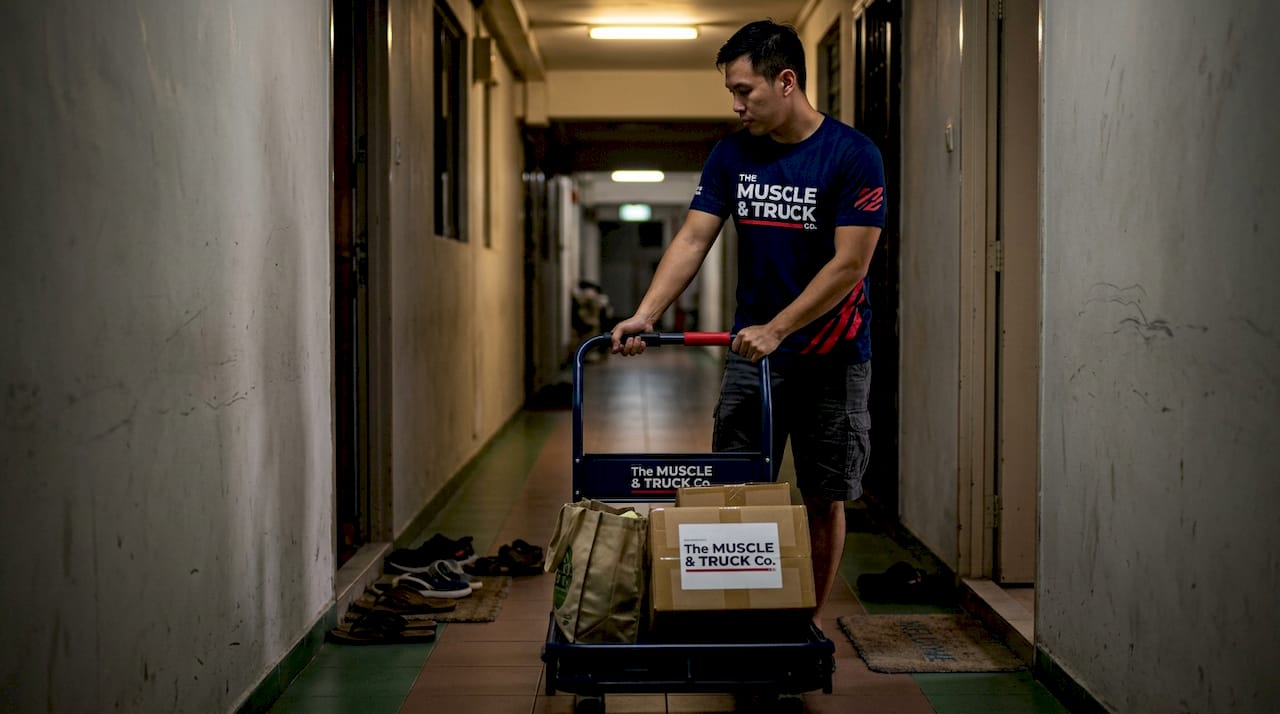
A foldable trolley is worth every cent if you are moving through HDB corridors. It reduces back strain noticeably and speeds up loading when you are renting a van or truck by the hour. Keep your DIY moving checklist updated as you go, and refer to guidance on moving furniture safely to protect both yourself and your belongings.
Pro Tip: If you are packing solo, limit sessions to two to three hours at a time. Packing while exhausted leads to poor decisions, like putting heavy items in oversized boxes, which then become impossible to carry safely.
Risks of damage and insurance limitations when packing yourself
Understanding these risks adds clarity about the consequences beyond time and money.
When you pack your own boxes, you take on full responsibility for how well those items are protected. Inadequate padding, wrong box sizes, and poor stacking are the three most common reasons belongings are damaged during a DIY move. A ceramic vase wrapped in a single layer of newspaper inside an oversized box will almost certainly arrive broken.
The insurance gap here is significant and widely misunderstood. Most moving insurance policies exclude damage caused by inadequate internal packing when the owner packs their own boxes. Coverage typically applies only to mishandling by the carrier, meaning if your box is dropped, you may be covered, but if it was poorly packed to begin with, the insurer will reject the claim.
This matters particularly for:
- Electronics: Screens crack easily if boxes are not padded properly or if they are stacked under heavier items.
- Glassware and ceramics: These require individual wrapping and dedicated boxes. Mixed packing with harder objects leads to breakage.
- Artwork and mirrors: Flat, fragile items need specialised wrapping and vertical loading, something most DIY packers do not know to do.
- Antiques and valuables: These are rarely covered even by professional movers without specific declared-value policies.
Before you start packing, photograph every room and every valuable item. A timestamped visual record gives you a reference point if something arrives damaged and you need to raise the issue with your mover.
For movers who want the benefits of DIY packing without the full risk, there are practical middle-ground options. Read more about moving without a packing service to understand how to structure your move so that you control costs while the heavy logistics are handled by professionals.
How to decide if packing yourself suits your move in Singapore
With risks known, here is how to evaluate if packing yourself is right for your move.
Not every move is the same, and the right answer depends heavily on your specific situation. DIY packing suits studios and 1-2 room HDB flats far better than larger homes. Bigger spaces mean more items, more time, and greater risk of error or injury. Beyond home size, those with tight schedules, fragile belongings, or high-value items typically benefit from at least partial professional packing.
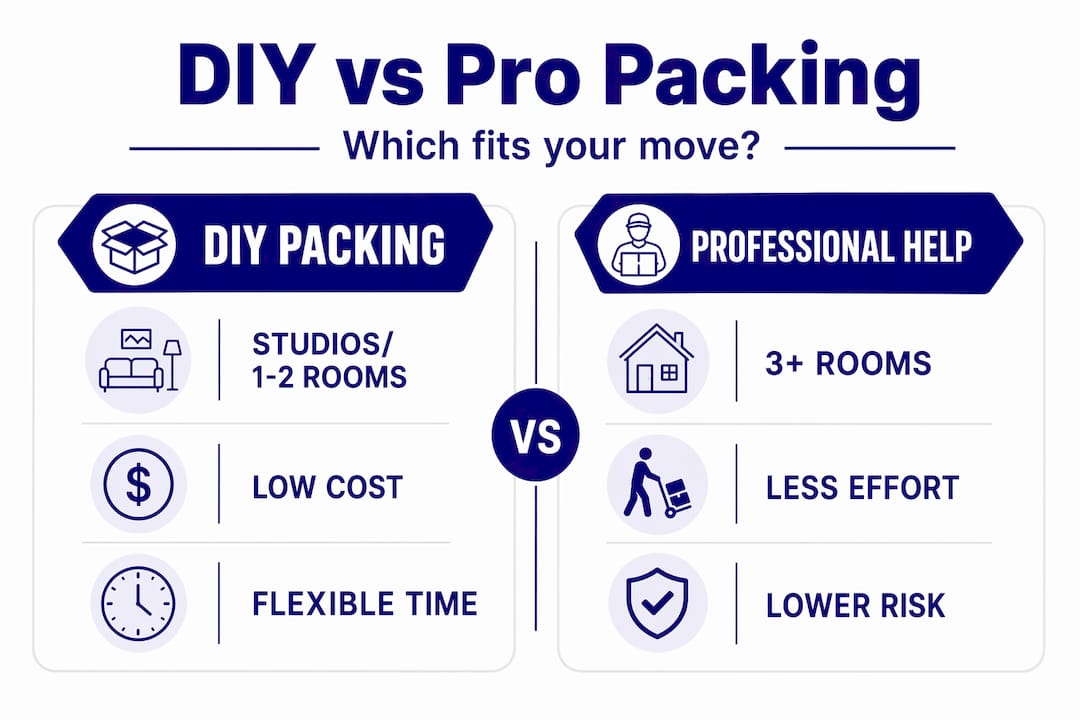
| Factor | DIY packing suits you | Consider professional help |
|---|---|---|
| Home size | Studio or 1-2 room HDB | 4-room HDB or larger |
| Item type | General household goods | Fragile, antique, or high-value items |
| Available time | Two or more free weekends | Limited time before move date |
| Physical health | Fit, no joint or back issues | Existing injuries or medical conditions |
| Budget | Tight, willing to invest effort | Prefer predictability and peace of mind |
| Packing experience | Have moved before | First-time mover |
Use this table as a starting point, not an absolute rule. A person moving a 2-room flat with a collection of delicate ceramics may still benefit from professional packing for just that one category, while handling the rest themselves.
Key questions to ask yourself before deciding:
- Do I have at least two full weekends available before the move date?
- Are there items that cannot be replaced if damaged?
- Am I physically capable of sustained lifting and packing without injury?
- Do I understand how to pack each category of item safely?
For guidance on choosing movers in Singapore that fit your budget, or to explore small move solutions that complement DIY packing, plan your approach early to avoid rushed decisions close to moving day.
Expert tips for efficient and safe DIY packing in Singapore
If you opt for DIY packing, these expert tips help make the process smoother and safer.
Good self-packing is not about working harder. It is about working smarter. Professionals use specific techniques for box uniformity, weight distribution, and labelling that any DIY mover can adopt with a bit of preparation.
- Use uniform box sizes: Standard-sized boxes stack cleanly in a van, reducing wasted space and preventing boxes from toppling. Mismatched boxes create unstable towers.
- Match weight to box size: Heavy items like books, tools, and appliances go into small boxes. Light items like pillows and linens go into large boxes. This prevents overloading and makes lifting safer.
- Wrap items individually: Each breakable item should have its own layer of bubble wrap, secured with tape. Do not rely on neighbouring items to cushion each other.
- Label every box clearly by room: Write the destination room and a brief contents description on the top and at least one side of each box. This means your movers know exactly where each box goes, saving unpacking time.
- Pack an essentials box last: Fill one clearly marked box with what you need on the first night, including phone chargers, toiletries, a change of clothes, and important documents. Load it last so it comes off the truck first.
- Use a foldable trolley throughout: A trolley in HDB corridors is not a luxury. It protects your back and cuts loading time significantly, especially if you are renting a truck by the hour.
Pro Tip: Use colour-coded tape for each room. One roll of blue tape for the bedroom, red for the kitchen, yellow for the living room. It takes five minutes to set up and saves hours of confusion during unpacking.
Reading through a guide on preparing for your movers before your moving day ensures your packed boxes are ready in the right position and that the actual loading process runs without delay.
The overlooked truth about packing yourself: time is often the real currency
Most articles on DIY packing focus on dollars saved. Fewer talk honestly about what you are actually spending when you take on the packing yourself, and that is time, energy, and mental bandwidth during an already stressful period.
Time flexibility is genuinely the strongest argument for packing yourself. You can pack at your own pace, revisit rooms when you are ready, and organise your belongings in a way that reflects how you actually live. That level of control is something no hired packer can replicate.
But that same flexibility carries a trap. Because you can spread packing over several weeks, many people do, and the move ends up dominating their entire month. Boxes sit half-packed in the living room. You cannot find your kitchen scissors. The house feels chaotic for three weeks instead of three days. DIY packing frequently extends stress, adds hidden expenses, and depletes physical reserves in ways most movers do not anticipate until they are in the middle of it.
The most practical approach we have seen work consistently is a hybrid model. Pack the straightforward items yourself, such as clothes, books, linens, and non-fragile kitchenware. Get professional help or at minimum professional materials and guidance for anything fragile, valuable, or oversized. Then focus your energy on securing affordable moving help for the transport leg, where professional efficiency genuinely saves both time and money.
The real question is not whether you can pack yourself. Most people can. The question is whether doing so leaves you in good shape to actually enjoy settling into your new home, or whether you arrive exhausted, stressed, and already behind on everything else.
Simplify your DIY move with The Muscle & Truck Co.
You have done the hard work of packing everything yourself. The last thing you need is an overpriced, full-service moving quote for items that are already boxed, labelled, and ready to go. At The Muscle & Truck Co., we offer straightforward truck and manpower services built specifically for movers with pre-packed belongings. No upsells, no unnecessary add-ons.
Our transparent, hourly pricing means you only pay for the time and labour you actually use. Booking is fast and simple, with an instant online quote so you know exactly what to expect before moving day. Whether you are shifting a studio flat or clearing a small office, we handle the heavy lifting and transport so you can focus on settling in. Get your instant moving quote today and see how affordable a well-planned DIY move can be.
Frequently asked questions
Is packing belongings myself always cheaper than hiring professionals?
Not always. While DIY packing removes labour costs, materials cost SGD 200 to 400 and the risk of damage to belongings can quickly erase those savings.
What home sizes are best suited for packing your belongings yourself in Singapore?
Studios and 1-2 room HDB flats are best suited for DIY packing, as larger homes typically require professional assistance to avoid exhaustion and an increased risk of damage.
Does packing my own boxes affect moving insurance coverage?
Yes. Most insurance policies exclude damage caused by the owner’s internal packing, covering only mishandling by the carrier during transport.
What are essential tools to reduce injury risk when packing myself?
A foldable trolley is the single most impactful tool, as it reduces back strain significantly in HDB corridors. Combine it with proper lifting technique and scheduled rest breaks throughout the day.
How can I organise my packing efficiently if I choose to do it myself?
Use standardised boxes and room-based labelling to keep things organised, and always pack heavy items into small boxes with lighter items in larger ones for safer lifting and cleaner stacking.
Recommended
- Essential checklist for first-time DIY home movers in Singapore – The Muscle & Truck Co.
- A practical guide to moving without full service movers – The Muscle & Truck Co.
- How to move furniture in Singapore: safe, affordable tips – The Muscle & Truck Co.
- Pre-packed moving: save time and costs in Singapore – The Muscle & Truck Co.