
Limited-service moving is defined as hiring professional help for specific parts of your move, such as loading, unloading, or packing, while you retain responsibility for transport, scheduling, and overall logistics. In the moving industry, this is also called labour-only moving or partial moving service. It sits between full-service moving and a complete DIY approach, giving you professional muscle where you need it most without paying for services you can manage yourself. For individuals and small businesses in Singapore watching their budgets, understanding this option can mean the difference between an affordable move and an unnecessarily expensive one.
What is limited-service moving and what does it cover?
Limited-service moving means hiring movers for only part of the job, such as loading and unloading or packing, while you handle transportation and most planning. The industry terms you will encounter most often are labour-only moving, partial moving service, and moving labour hire. All three describe the same core idea: you purchase specific labour capacity rather than an all-in logistics contract.
The scope of what is covered varies by provider, but most limited-service arrangements fall into a few recognisable patterns:
- Labour-only loading and unloading: Movers arrive at your location, load your pre-packed belongings onto a rented truck or container, and unload at the destination. You drive or arrange the vehicle.
- Packing assistance only: Movers help pack your items into boxes, but you handle transport and unloading.
- Partial services: A combination of tasks, such as loading plus basic furniture placement, without full logistics management.
Pro Tip: Before booking, write down exactly which tasks you want help with and which you will handle yourself. Providers like Themuscleandtruck price by the hour, so a clear scope prevents billing surprises.
What the mover does not handle in a limited-service arrangement is equally important. You remain responsible for booking the truck or container, coordinating access to both properties, managing timing, and arranging insurance for your belongings in transit. This is the trade-off that makes labour-only help cost-effective: you are buying physical effort, not project management.

How does limited-service moving compare with full-service and self-service?
Understanding where limited-service sits on the spectrum helps you choose the right option for your situation. Full-service movers typically handle packing, loading, transport, unloading, furniture disassembly and reassembly, and provide all moving supplies. Limited-service movers provide only select labour tasks. Self-service means you manage everything, from packing to driving the truck, with no professional help at all.
| Service type | Labour provided | Transport | Scheduling | Typical cost | Best suited for |
|---|---|---|---|---|---|
| Full-service | All tasks | Included | Managed by mover | Highest | Large, complex, or long-distance moves |
| Limited-service | Selected tasks only | Customer arranges | Shared responsibility | Mid-range | Budget-conscious local moves with some physical capacity |
| Self-service | None | Customer arranges | Customer manages | Lowest | Very small moves or those with ample time and help |
The key trade-off is convenience versus cost. Full-service is more expensive but less stressful, and suits larger or more complex moves. Limited-service shifts more work and coordination back to you, lowering the price but increasing your effort. Self-service offers the most timing control but demands the most from you physically and logistically.
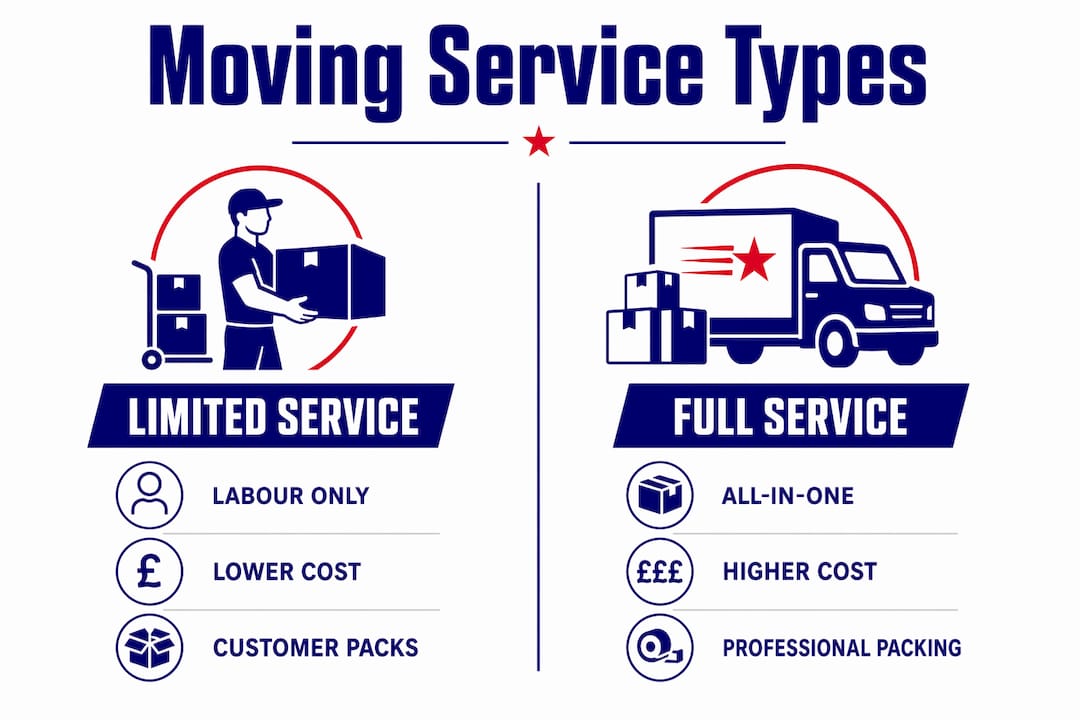
Hybrid approaches are also common. A small business relocating an office might hire labour-only movers for the heavy furniture while managing the packing of files and electronics internally. An individual moving a studio flat might rent a van and hire two movers for two hours to handle the sofa and wardrobe. These blended models are where limited-service options genuinely shine, because you pay only for what you cannot reasonably do yourself.
The decision between service levels depends on four factors: your budget, the distance of the move, your available time, and how much physical effort you are willing to take on. Local or budget moves favour limited or self-service with added labour help as needed, while large or long-distance moves often favour full-service.
What are the benefits and limitations of limited-service moving?
The primary benefit of limited-service moving is cost. You pay only for the specific labour you need, which is far cheaper than a full-service package that bundles in transport, supplies, and project management you may not require. For a small business or individual on a tight budget, this is a meaningful saving.
The benefits go beyond price alone:
- Greater scheduling flexibility. You control when the truck arrives and how long the job takes, rather than fitting into a mover’s fixed schedule.
- More control over your belongings. You pack your own items, which means you know exactly how fragile things are wrapped and where everything is.
- Scalability for small moves. A one-bedroom flat or a small office relocation rarely justifies a full-service package. Labour-only help scales to the actual size of the job.
- Reduced physical strain without full cost. Labour-only services save you from the heaviest lifting while keeping overall costs down.
The limitations are equally real and worth understanding before you commit.
Pro Tip: Always confirm whether your rented truck or container rental includes transit insurance. Most limited-service movers cover their labour only, not your goods in transit. Check with your home or business contents insurer before move day.
Limited-service moving demands careful coordination and physical effort, making it best for those comfortable managing parts of the move themselves. If your timeline is tight, your items are high-value, or the move involves multiple floors and complex logistics, the cost savings can quickly be eroded by delays, damage, or the need to extend labour hours. Hidden costs such as rental equipment fees, fuel, and extended labour time are the most common reasons a limited-service move ends up costing more than expected.
How to plan effectively for a limited-service move
Effective planning is what separates a smooth limited-service move from a stressful one. Deciding which tasks to outsource and scheduling labour help properly are the two most critical steps.
Start with a clear task audit. Write down every task the move requires, then mark each one as “outsource” or “self-manage.” Heavy furniture, large appliances, and bulky items are the clearest candidates for professional labour. Packing personal items, dismantling flat-pack furniture, and coordinating building access are tasks most people can handle themselves.
- Book your transport first. Whether you are renting a van, hiring a lorry, or using a container service, confirm the vehicle before you book your labour. The labour team needs to know the truck size and arrival time.
- Confirm access at both ends. Check lift availability, loading bay restrictions, and parking permits at both your current and new address. Delays here cost you money when you are paying by the hour.
- Prepare your belongings before the movers arrive. All boxes should be sealed, labelled, and grouped by room. Furniture to be moved should be cleared of drawers and loose items. This is the single biggest factor in keeping labour hours within budget.
- Build a buffer into your timeline. Add at least one hour to your estimated labour time. Unexpected delays, such as a lift being occupied or a sofa that will not fit through a door, are common.
- Clarify what the movers will and will not do. Some partial moving services include basic furniture placement; others do not. Confirm the scope in writing before the job starts.
For small businesses, treating the move as a procurement exercise is useful. You are buying a specific quantity of labour capacity for a defined set of tasks. This framing helps you scope the job accurately, compare quotes fairly, and avoid scope creep on move day.
Self-storage can also play a practical role in a limited-service move. If your new premises are not ready on the same day your old ones need to be vacated, self-storage in logistics can bridge the gap without requiring you to rush or pay for extended labour time.
Common misconceptions about limited-service moving
The most persistent misconception is that limited-service moving is inherently hassle-free because it costs less. It is not. You still manage significant logistics, and the coordination burden falls squarely on you.
A few other misconceptions are worth addressing directly:
- “It will definitely be cheaper.” Cost savings depend heavily on accurate planning and realistic timelines. If labour hours run over or you need to make multiple trips, the savings shrink fast.
- “It works for any move.” Limited-service is not always suitable for complex, long-distance, or high-value moves. A business relocating specialist equipment or a household with antiques is better served by full-service providers who carry appropriate insurance and expertise.
- “The movers will figure out the details.” Labour-only movers are there to lift and carry, not to manage your move. Clear communication with your provider before the job is non-negotiable.
- “Hidden costs are rare.” Rental equipment fees, fuel surcharges, staircase levies, and extended labour hours are all common additions that can catch unprepared movers off guard.
Understanding these realities does not make limited-service moving a poor choice. It makes it a smarter one, because you go in with accurate expectations and a plan that accounts for the real costs and effort involved.
Key takeaways
Limited-service moving delivers genuine cost savings and flexibility, but only when you plan the logistics, scope the tasks accurately, and account for the coordination effort it requires.
| Point | Details |
|---|---|
| Core definition | Limited-service moving covers specific tasks like loading or packing; you manage transport and scheduling. |
| Cost vs effort | Lower cost comes with greater personal coordination; hidden fees can erode savings without careful planning. |
| Best use cases | Ideal for local, small-scale moves where you have time, physical capacity, and pre-packed belongings. |
| Planning is critical | Book transport first, prepare belongings in advance, and confirm access at both ends before move day. |
| Know the limits | Not suited for complex, long-distance, or high-value moves where full-service expertise and insurance matter. |
Why limited-service moving deserves more honest attention
I have seen a lot of people approach limited-service moving with one of two attitudes: either they think it is a guaranteed bargain, or they dismiss it as too complicated. Both views miss the point.
The honest reality is that limited-service moving is a genuinely smart option for the right situation. A single professional moving a one-bedroom flat across town, or a small business shifting a compact office, does not need a full-service package. Paying for project management, packing materials, and a dedicated move coordinator when you are capable of handling those tasks yourself is simply wasteful.
What I find most useful is the framing of limited-service as purchasing labour capacity rather than buying a complete moving solution. When you think of it that way, the decision becomes much clearer. You are not choosing a “lesser” service. You are choosing the specific service you actually need.
Where I would caution people is on the planning side. The moves that go wrong are almost always the ones where someone underestimated the preparation required. Boxes that are not sealed, furniture that has not been measured against doorways, lifts that have not been pre-booked. These are not the mover’s problems to solve. They are yours.
If you go into a limited-service move with a clear task list, a confirmed vehicle, and your belongings ready before the team arrives, you will almost certainly have a smooth experience. If you treat it as a casual arrangement where the details will sort themselves out, you will pay for that assumption in overtime hours and stress.
— Jessica
Get moving with Themuscleandtruck
If you have decided that a limited-service move is the right fit, Themuscleandtruck makes it straightforward to get started. The service is built specifically for customers who have their belongings pre-packed and need reliable truck and manpower support without paying for a full-service package.

Themuscleandtruck offers transparent, hourly-priced truck and labour services for short-distance and small-scale moves across Singapore. Scheduling is flexible, quotes are instant, and the scope is honest: you know exactly what you are getting before you commit. Backed by the reputation of sister brand CYC Movers, the team brings real experience to every job. Get an instant quote today and see exactly what your move will cost before you book.
FAQ
What is the difference between limited-service and full-service moving?
Full-service movers handle every aspect of a move, including packing, transport, unloading, and furniture reassembly. Limited-service movers provide only selected tasks, such as loading and unloading, while you manage transport and scheduling yourself.
Is limited-service moving cheaper than hiring full-service movers?
Limited-service moving is generally cheaper because you pay only for the labour tasks you need. However, costs can increase if planning is poor, timelines extend, or rental equipment and access fees are not accounted for in advance.
What tasks do limited-service movers typically handle?
Labour-only movers most commonly handle loading and unloading, with some providers also offering packing assistance or basic furniture placement. Transport and logistics coordination remain the customer’s responsibility.
Is limited-service moving suitable for small businesses?
Yes. Small businesses relocating compact offices or retail spaces are well-suited to limited-service options, particularly when they can manage packing internally and need professional help only for heavy lifting and transport logistics.
What are the most common hidden costs in a limited-service move?
The most frequently overlooked costs include vehicle rental fees, fuel, staircase or floor levies, extended labour hours, and transit insurance. Confirming all fees with your provider before move day prevents unexpected charges.
Recommended
- What is partial moving service? A clear guide – The Muscle & Truck Co.
- A practical guide to moving without full service movers – The Muscle & Truck Co.
- How to plan a small move: your step-by-step guide – The Muscle & Truck Co.
- Cost-saving small move solutions in Singapore explained – The Muscle & Truck Co.