
Most people planning a move think about boxes, bubble wrap, and booking dates. The moving truck is almost an afterthought. That is a mistake. The role of moving trucks goes far beyond simply carting your belongings from one address to another. A truck determines your loading sequence, your route, your timing, and ultimately whether your furniture arrives in one piece. Get the truck right and everything else falls into place. Get it wrong and you are dealing with damaged goods, missed windows, and unexpected costs before you have even unpacked a single box.
Table of Contents
- Key takeaways
- The role of moving trucks in relocation logistics
- Types of moving trucks and what they do
- Trucks as the logistics hub of your move
- Loading and securing your belongings
- Moving truck rental: options and benefits
- Moving trucks versus alternative solutions
- My honest take on moving trucks
- Ready to move? Themuscleandtruck can help
- FAQ
Key takeaways
| Point | Details |
|---|---|
| Trucks shape logistics, not just transport | The moving truck coordinates timing, route planning, and load sequence for the entire move. |
| Truck size must match your move | Choosing the wrong size costs money and causes loading problems that damage your belongings. |
| Loading sequence is critical | Load heavy items first and near the cab; fragile items go in last and come out first. |
| Rental trucks offer real flexibility | For individuals and small businesses, truck rental avoids ownership costs and scales to your exact needs. |
| Access and manoeuvrability matter | Local restrictions, tight roads, and parking can dictate truck choice as much as cargo volume does. |
The role of moving trucks in relocation logistics
A moving truck is not just a container on wheels. From a logistics standpoint, the truck is a control point that reduces friction and directly affects delivery reliability. Think of it this way: the truck dictates when you can start loading, how long the job takes, which routes you can realistically drive, and how your belongings are staged for unloading at the other end.
For local moves, the truck’s role is fairly contained. You load, drive a short distance, unload. But even here, choosing the wrong truck size means multiple trips or wasted space you are paying for. For long-distance relocations, the stakes are higher. Items spend days on the road, exposed to vibration, shifting, and varying road conditions. The truck becomes a mobile storage unit that must be loaded with the same discipline as a warehouse.
Moving truck drivers handle contract preparation, dispatcher communication, vehicle inspection, and unloading supervision. These are not peripheral tasks. They are the operating fabric of a move. When you understand that, you start to see why the truck choice, loading plan, and route strategy matter so much.
Types of moving trucks and what they do
Not all moving trucks serve the same purpose. The vehicle you choose should match your cargo volume, your destination, and the access conditions at both ends of your move.
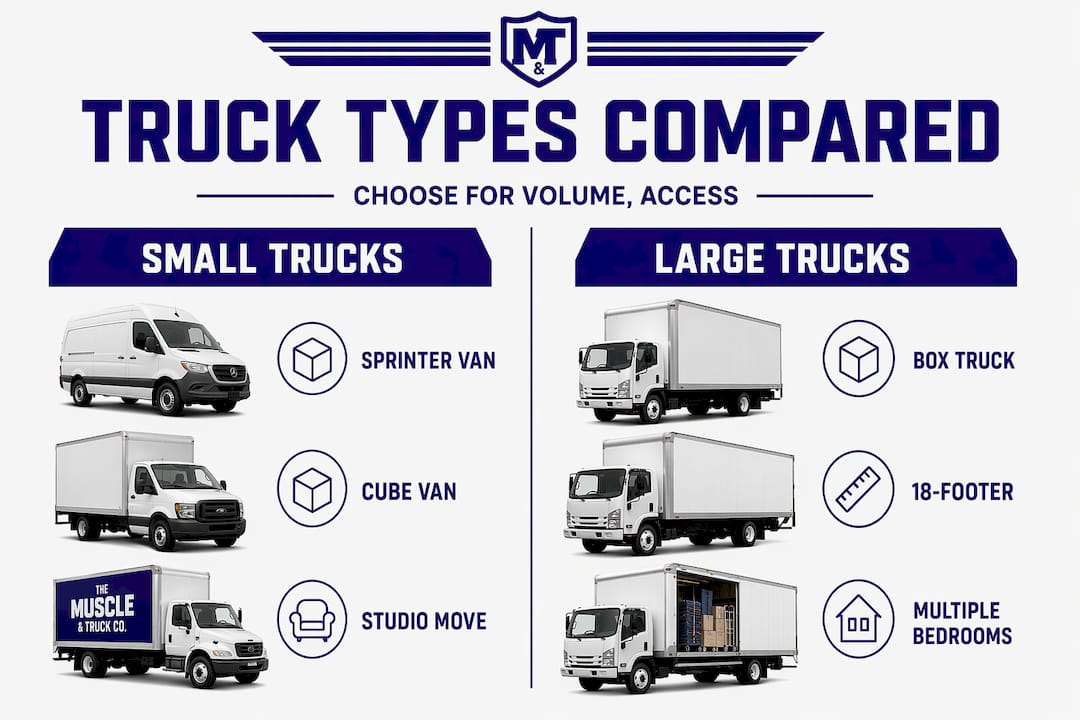
Here is a quick overview of the most common options:
| Truck type | Typical capacity | Best suited for |
|---|---|---|
| Sprinter van / cube van | Studio to 1-bedroom flat | Small moves, fragile cargo, tight streets |
| Box truck (medium) | 2 to 3-bedroom home | Most residential and small business moves |
| Large box truck | 3 to 4-bedroom home | Larger household moves with bulky furniture |
| Tractor trailer | Commercial or full-house loads | Long-distance, high-volume relocations |
Payload capacity and interior dimensions are what you need to scrutinise. A truck that looks large enough from the outside can have a lower roof height or a shorter interior than you expect. Ramps and lift gates also matter. A built-in ramp significantly reduces the effort of loading heavy furniture and reduces injury risk.
Newer truck models are closing the gap between ease of driving and load capacity. U-Haul’s ‘Easy Mover’ features ergonomic controls, a quiet cab, and numerous safety enhancements, with no commercial driving licence required. This kind of design matters for individuals taking charge of their own move.
Pro Tip: If you are driving a box truck for the first time, choose a model with a low step-in height and an automatic gearbox. You will spend less energy managing the vehicle and more focus on driving safely.
One factor that often catches people out: larger trucks cannot always reach the front door. Tight residential streets, height restrictions, and no-parking zones may require you to use a smaller vehicle for the first or last leg. Planning for this in advance avoids expensive delays on moving day.
Trucks as the logistics hub of your move
The decisions you make around your truck ripple through your entire moving plan. Route selection is one example most people skip entirely. A driver who has not checked for low bridges, weight-restricted roads, or peak-hour congestion can lose hours on a move that should take 30 minutes.
Timing is equally tied to the truck. You cannot start loading before the truck arrives. You cannot vacate a property until the truck is fully loaded. Every delay in the truck schedule pushes back every other task in your day. This is why experienced movers treat truck availability as the anchor point for the entire moving-day timeline.
Loading sequence is where the logistics become genuinely technical. As a principle:
- Load the heaviest items first and place them on the floor of the truck, close to the cab
- Build upward with medium-weight boxes, securing each tier with straps
- Place fragile items and lighter boxes last, cushioned against walls or padding
- Keep frequently needed items accessible near the rear of the truck
For long-distance moves, the loading order mirrors the unloading order in reverse. Fragile items are loaded last so they come off first, reducing the risk of heavy boxes being shifted repeatedly during the journey.
A well-loaded truck arrives at its destination in nearly the same condition it left. A poorly loaded truck is an insurance claim waiting to happen.
For small businesses managing office relocations, the logistics layer is even more significant. Equipment, filing systems, and furniture all need to be mapped to a loading plan that mirrors the layout of the new space. The moving truck is not just transport. It is a staging mechanism.
Loading and securing your belongings
Safe loading is both a skill and a science. Most moving damage comes from poor load stability rather than rough handling. Shifting and sway during braking, turning, or driving on uneven roads is the primary cause of breakage and furniture damage. The good news: it is entirely preventable with the right approach.
Follow these steps for a safe, stable load every time:
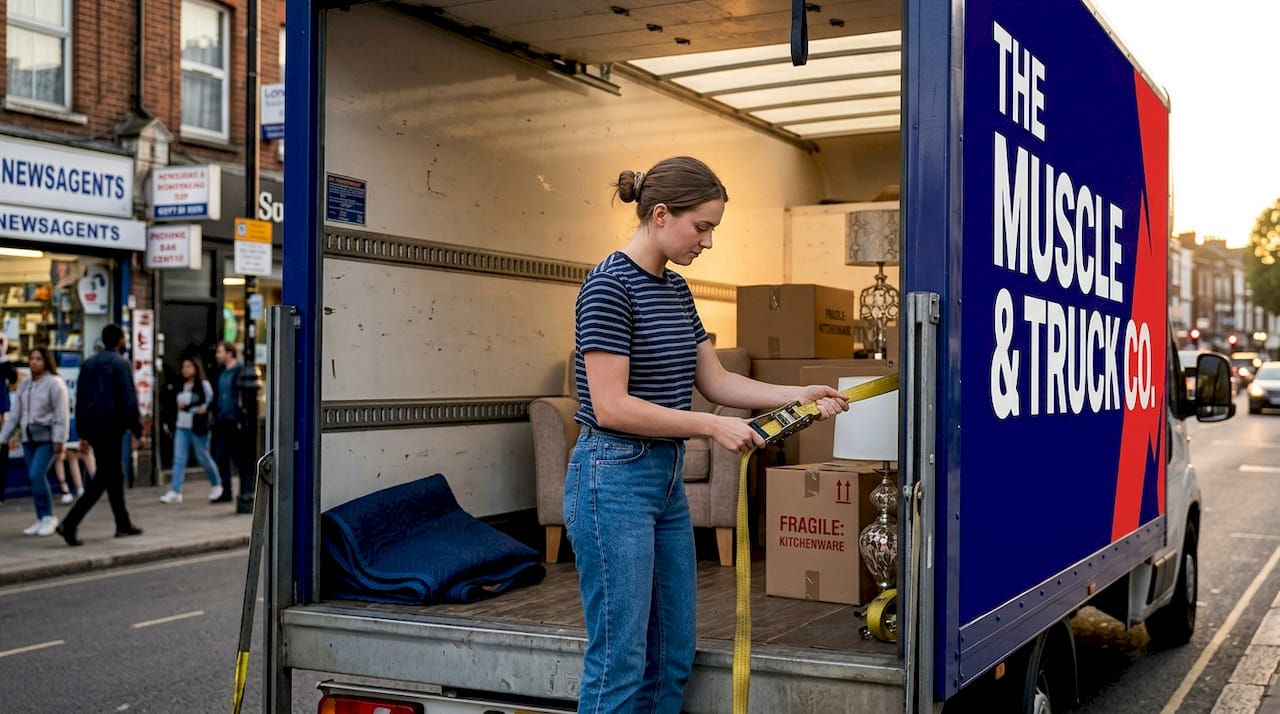
- Clear the floor first. Place the heaviest items, wardrobes, appliances, and bed frames flat on the truck floor. Keep the weight low and centred over the axles.
- Work in tiers. Stack medium-weight boxes on top of furniture, forming consistent rows. Strap each tier to the truck’s interior anchor points before adding the next layer.
- Fill the gaps. Empty space is your enemy. Gaps allow boxes to shift. Use soft items like bedding, cushions, and rolled rugs to fill voids.
- Protect the surfaces. Use moving blankets or bubble wrap on furniture corners, glass surfaces, and anything that can scratch. Secure these with packing tape, not rope, which can cut into surfaces.
- Load fragile items last. Keep them in clearly labelled boxes and place them on top, facing upward, against a padded wall.
Pro Tip: Hire or purchase ratchet straps rather than bungee cords. Bungee cords stretch under load and lose tension during transit. Ratchet straps hold their tension over long distances and on rough roads.
Checking the load after the first 10 to 15 minutes of driving is worth doing. Pull over, open the rear, and inspect whether anything has shifted. Correcting a problem early is far easier than dealing with damage at the end.
Moving truck rental: options and benefits
The role of truck rental in moving is often underestimated. For individuals and small businesses, renting a truck gives you control over timing, capacity, and cost in a way that full-service moving companies do not.
Key benefits of rental trucks include:
- Capacity flexibility. You choose the exact size you need. No paying for a full crew to move a one-bedroom flat.
- Cost control. Rental rates are transparent and predictable, especially for local moves.
- Timing on your terms. You load when you are ready, not when a booking window opens.
- No ownership costs. Maintenance, insurance, and storage are the rental company’s problem.
Commercial truck rentals help businesses manage unpredictable demand, reduce maintenance downtime, and maintain service levels without long-term asset commitments. This applies equally to small businesses moving premises or managing seasonal stock relocations.
Before you book, understand the requirements. Most truck rentals require a government-issued licence, a credit or debit card, and age verification for any additional drivers. International permits may apply for cross-border moves. Some providers accept cash with a deposit.
For minimalist moves in Singapore, truck rental for smaller loads is a practical, cost-effective solution that avoids paying for capacity you do not need.
Moving trucks versus alternative solutions
Choosing between a moving truck and other solutions is not always straightforward. The right answer depends on your load volume, your budget, and the physical conditions at your origin and destination.
Here is how the options compare:
| Solution | Best for | Key limitation |
|---|---|---|
| DIY truck rental | Confident movers with pre-packed loads | Requires your own labour and driving |
| Man-with-a-van service | Small loads, last-minute moves | Limited capacity for large households |
| Full-service moving company | Large or complex moves | Higher cost, less scheduling flexibility |
| Themuscleandtruck model | Pre-packed loads needing truck and manpower | Not suited for fragile or specialist items |
Independent truck rental works best when you have pre-packed and labelled your belongings, have helpers available, and want to manage your own timeline. Full-service movers are better suited to households with high-value items, complex dismantling requirements, or limited ability to pack in advance.
Manoeuvrability is also a deciding factor. Vehicle choice can be driven more by access restrictions than cargo volume. A tractor trailer might carry everything in one go but cannot physically reach a third-floor walk-up in a narrow lane. In these cases, a smaller vehicle with multiple trips, or a two-vehicle strategy, is more practical than forcing a large truck where it cannot go.
Modern logistics tools, including fleet GPS and video tracking, are also changing how moving companies manage their fleets, giving customers better delivery windows and reducing costly delays.
My honest take on moving trucks
I have spent years working with movers, talking to people mid-relocation, and seeing the aftermath of moves that went sideways. Here is what I have learnt: people consistently underestimate how much the truck itself shapes the outcome.
The assumption is that any truck will do. Just get one big enough, drive it over, and everything will be fine. But I have seen people book trucks that are too large for their street, only to spend the morning doing relay runs with a trolley. I have seen loads that were never strapped, arriving with furniture that looked like it had been in a minor collision.
What actually works is treating the truck decision as the first logistics decision of your move, not the last. What size do you genuinely need? What access conditions exist at both ends? Do you need a ramp, a lift gate, or padded walls? These questions take ten minutes to answer and save hours on moving day.
For small businesses, the case for rental trucks is even stronger than most owners realise. Rental trucks provide operational resilience, letting you adapt to shifting timelines without committing to owned vehicles. That flexibility alone is worth the rental premium over doing nothing and hoping for the best.
The truck is not background logistics. It is the centrepiece of your move.
— Jessica
Ready to move? Themuscleandtruck can help
If you have pre-packed your belongings and need reliable transport with manpower in Singapore, Themuscleandtruck makes the process simple. The service is built around transparent hourly pricing for truck and labour, with no hidden fees and no requirement to pay for packing services you do not need.
You can get an instant quote in minutes, with no obligation. The booking process is clear, the pricing is honest, and the team handles the heavy lifting while you manage the load. Whether you are moving a studio flat or relocating a small office, Themuscleandtruck offers a straightforward, affordable solution that sits between full-service movers and complete DIY. Visit Themuscleandtruck to find out exactly what is included and how quickly your move can be arranged.
FAQ
What is the role of moving trucks in a relocation?
Moving trucks coordinate the logistics of your entire move, including loading sequence, route planning, and timing. They are the central point around which every other moving task is organised.
How do I choose the right size moving truck?
Match the truck size to your number of rooms and the volume of your belongings. A medium box truck suits most two to three-bedroom homes, while a sprinter van is adequate for studio or one-bedroom moves with pre-packed loads.
What are the main benefits of renting a moving truck?
Rental trucks give you flexibility in timing, capacity, and cost. You only pay for the size you need, avoid ownership and maintenance costs, and move on your own schedule.
How should I load a moving truck safely?
Place the heaviest items on the floor near the cab, build upward in strapped tiers, fill gaps with soft items, and load fragile boxes last. Poor load stability causes most moving damage, not rough handling.
Do I need a special licence to drive a moving truck?
For most box trucks used in residential moves, a standard driving licence is sufficient. Newer models like U-Haul’s Peterbilt trucks are specifically designed to be driven without a commercial licence, making them accessible for first-time renters.