
A list of essential moving tools is defined as the physical items required to pack, protect, transport, and secure belongings safely without professional packing assistance. For individuals and small businesses handling their own moves, having the right moving equipment list in place before moving day is the single biggest factor separating a smooth relocation from a chaotic one. Sources including Lowe’s, Extra Space, Move.org, and United Van Lines all recommend similar core kits containing boxes, tape, cushioning, hand tools, dollies, and straps. Getting this right from the start saves time, protects your belongings, and reduces physical strain considerably.
1. Boxes and packing materials: the foundation of every move
The right boxes are the backbone of any moving tool checklist. Using multiple sizes is not optional. Small boxes carry heavy items like books and tinned goods, keeping weight manageable. Medium boxes handle miscellaneous household items such as kitchenware and folded clothing. Large boxes are reserved for lightweight but bulky items like pillows, duvets, and lampshades.
Beyond standard sizes, specialty boxes serve specific purposes that generic cartons cannot. Wardrobe boxes include an internal hanging rail, allowing clothes to travel upright without creasing. Dish pack boxes feature double-walled construction and internal dividers, making them the safest option for crockery and glassware.
For cushioning, you have three main options:
- Bubble wrap for fragile items with air pockets that absorb impact
- Packing paper for wrapping individual items and filling void space in boxes
- Foam sheets or foam pouches for electronics, lenses, and delicate ornaments
Plastic stretch wrap is one of the most underrated packing tools for relocation. It holds drawers shut, bundles cables together, and wraps upholstered furniture to keep it clean during transit. Moving blankets protect mirrors, artwork, and large appliances from scratches and surface damage. Lowe’s specifically recommends them for floor and appliance protection during transport.
Pro Tip: Reuse boxes from supermarkets or online retailers, but inspect each one carefully for moisture damage or structural weakness before trusting it with your belongings. Pair every box with a quality tape dispenser rather than tearing tape by hand. It is faster, produces cleaner seals, and reduces wrist fatigue over a long packing session.
2. Hand tools and cutting implements for moving day
Every DIY mover needs a compact toolkit ready before the first box is taped shut. Core moving day tools include screwdrivers with assorted bits, a hammer, pliers, Allen keys, and an adjustable wrench. These cover the vast majority of furniture disassembly tasks you will encounter.
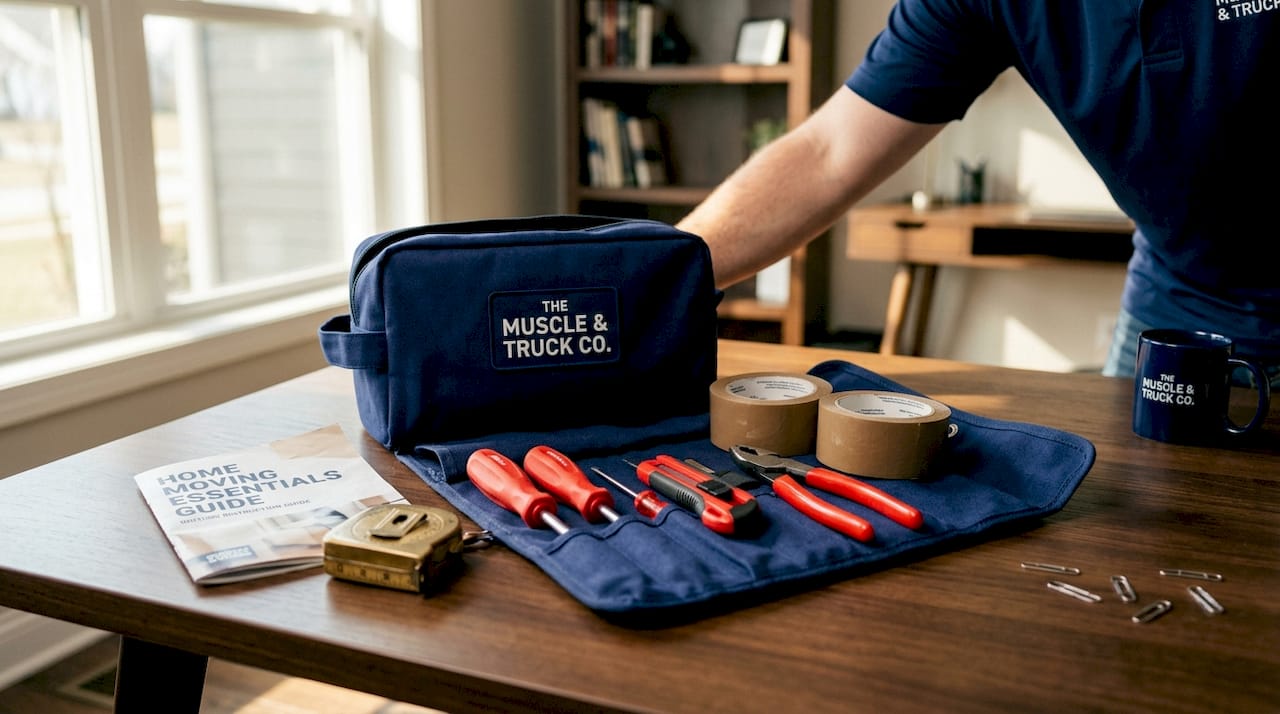
The items most people forget are the cutting tools. A sharp box cutter or utility knife is used constantly throughout a move, from breaking down flat-pack boxes to opening sealed cartons at the other end. A sturdy pair of scissors handles tape, twine, and plastic wrap. Both belong in your toolkit from day one.
Here is a quick reference for your hand tool checklist:
- Screwdriver set with Phillips and flathead bits
- Hammer for removing nails and tapping furniture joints apart
- Pliers for gripping, bending, and pulling
- Allen key set for flat-pack furniture bolts
- Adjustable wrench for bed frames and appliance fittings
- Box cutter or utility knife for opening and breaking down boxes
- Scissors for tape, twine, and plastic wrap
Pro Tip: Keep your toolkit in a clearly labelled bag that travels in the cab of the truck, not in the back. You will need it at both ends of the move for last-minute adjustments, tightening loose fittings, or reassembling furniture before the truck leaves.
3. Dollies, hand trucks, and lifting straps
Moving heavy items without mechanical assistance is the fastest route to a back injury or a damaged floor. Dollies and hand trucks are the most effective tools for reducing physical strain during a DIY move, and understanding the difference between types helps you choose correctly.
| Equipment | Best use | Typical rental cost |
|---|---|---|
| Two-wheeled upright hand truck | Appliances, tall boxes, single heavy items | Under $20 per day |
| Four-wheeled flat dolly | Stacks of boxes, furniture, large appliances | Under $20 per day |
| Lifting straps | Stairs, awkward angles, two-person lifts | Purchase recommended |
| Furniture sliders | Moving heavy items across hard floors | Purchase recommended |
Renting a dolly is the smarter choice for infrequent movers. Rental costs typically fall under $20 for a full day, which is far less than the cost of replacing a damaged item or treating a back injury. Purchasing makes sense only if you move regularly or manage a small business with ongoing logistics needs.
Lifting straps distribute weight across the shoulders and forearms rather than concentrating it in the lower back. They are particularly useful on stairs or when manoeuvring around tight corners. Furniture sliders reduce floor damage and allow one person to reposition heavy items across hard surfaces without lifting at all. Extra Space identifies sliders as a must-have for protecting both furniture and flooring during transit.
4. Securing tools to prevent shifting during transit
Load shifting inside a moving truck causes more damage than most people expect. The solution is proper securing equipment, and the choice of tool matters. Cargo straps and ratchet straps are the correct choice for anchoring heavy furniture to the side rails of a truck. Bungee cords are not a substitute for heavy loads. They stretch under tension and can snap or release unexpectedly.
Use the following securing tools correctly:
- Ratchet straps anchored to side rails for large furniture and appliances
- Cargo straps or thick rope for bundling and stabilising mid-weight loads
- Bungee cords only for keeping drawers closed or securing small groups of boxes
- Moving blankets placed between items to prevent surface contact and scratching
Proper load stabilisation with straps and tie-downs is frequently neglected due to under-preparation. Extra Space highlights this as one of the most common professional tips that DIY movers overlook. The technique matters as much as the equipment. Straps should be tensioned firmly, not just looped loosely around a piece of furniture. Always anchor to fixed points on the truck, not to other items in the load.
Placement strategy also reduces shifting. Load the heaviest items first against the cab wall, then fill gaps with medium boxes. Lighter items go on top. This weight distribution keeps the load stable and reduces the risk of items toppling during braking or cornering.
5. Labelling and organisation tools that speed up unpacking
A clear labelling system is the difference between an unpacking process that takes hours and one that takes days. Label every box on at least two sides with the room destination and a brief content description. Labelling only the top is useless once boxes are stacked.
Follow this labelling sequence for maximum efficiency:
- Write the room destination in large letters on two opposite sides of the box
- Add a content category below the room name (e.g., “Kitchen: pots and pans”)
- Assign a priority code: P1 for boxes to open first, P2 for within the first week, P3 for non-urgent items
- Number each box and record it in a simple inventory list on your phone or a notepad
- Apply a strip of colour-coded painter’s tape to the top of each box, one colour per room
Thick permanent markers readable from six feet away are the standard recommendation from professional movers. Thin ballpoint pens are illegible once boxes are stacked in a truck. Colour-coded painter’s tape by room is a visual shortcut that lets removal helpers sort boxes at the destination without reading every label individually.
Pro Tip: Take a photo of the inventory list on your phone before the truck leaves. If a box goes missing or ends up in the wrong room, you can cross-reference the number immediately without searching through every carton.
Professional movers label multiple faces of boxes with room codes, content categories, and priority levels to enable rapid unloading without confusion. Adopting this system for your own move removes guesswork and keeps helpers working efficiently.
Key takeaways
A complete moving tool checklist covering boxes, hand tools, lifting aids, securing straps, and a clear labelling system is the most reliable way to protect your belongings and complete a DIY move without avoidable damage or delays.
| Point | Details |
|---|---|
| Use multiple box sizes | Small boxes for heavy items, large boxes for lightweight bulky goods only. |
| Keep hand tools accessible | Store your toolkit in the cab, not the truck bed, for use at both ends. |
| Rent dollies for infrequent moves | Rental costs under $20 per day and prevents back injuries on heavy lifts. |
| Use ratchet straps, not bungee cords | Anchor furniture to truck side rails with ratchet straps for load stability. |
| Label boxes on two sides with priority codes | Multi-face labelling with colour-coded tape speeds unpacking significantly. |
What I have learned from watching DIY movers get it wrong
Most DIY moving mistakes come down to two things: under-preparing the toolkit and over-estimating how much you can carry without mechanical help. I have seen movers arrive with a single roll of tape, no dolly, and boxes labelled only on the top. By midday, the tape has run out, someone’s back is aching, and the unpacking destination looks like a warehouse with no system.
The tools that get skipped most often are the ones that matter most under pressure. Ratchet straps are ignored until something shifts in the truck. Furniture sliders are dismissed as unnecessary until a heavy wardrobe scratches a hardwood floor. A labelling system feels like extra work until you are searching through forty unlabelled boxes at 10pm.
My honest view is that a well-planned small move with the right tools is genuinely manageable for most individuals and small businesses. The toolkit does not need to be expensive. Renting a dolly, buying a roll of ratchet straps, and spending twenty minutes on a labelling system costs very little. The return on that small investment is a move that finishes on time, with no damaged furniture and no emergency trips to the hardware shop.
The one thing I would add that most checklists leave out: buy more packing tape than you think you need. Every experienced mover has run out mid-move. Double your estimate and you will still probably use it.
— Jessica
Ready to move? Themuscleandtruck makes the heavy lifting easier
You have packed the boxes, labelled every carton, and assembled your toolkit. The part that remains is getting everything from A to B safely. Themuscleandtruck provides hourly-priced truck and manpower services in Singapore, designed specifically for movers who handle their own packing. There is no need to pay for a full-service package when you have already done the preparation. Whether you need a truck and two crew members or just a vehicle for a small load, you can get an instant quote online in minutes. Transparent pricing, no hidden fees, and a team that respects your pre-packed belongings. Visit Themuscleandtruck to explore options and book your move.
FAQ
What is included in a basic moving tool checklist?
A basic moving tool checklist includes sturdy boxes in multiple sizes, packing tape, bubble wrap or packing paper, a box cutter, screwdrivers, Allen keys, a dolly or hand truck, ratchet straps, and permanent markers for labelling. Sources including Lowe’s and Extra Space recommend all of these as core necessary moving supplies for DIY movers.
Should I rent or buy a dolly for moving?
Renting is the better choice for most people. Dolly rental typically costs under $20 per day, which is far more economical than purchasing equipment you may only use once. Move.org recommends renting both upright two-wheeled and flat four-wheeled dollies depending on the items you are moving.
Are bungee cords safe for securing furniture in a moving truck?
Bungee cords are not suitable for securing heavy furniture during transit. Extra Space and Move.org both recommend ratchet straps or thick cargo ropes anchored to the truck’s side rails for heavy loads. Bungee cords are appropriate only for keeping drawers closed or bundling small groups of lightweight boxes.
How should I label boxes for an efficient move?
Label every box on at least two sides with the room destination, a content category, and a priority code. Use a thick permanent marker readable from six feet away, and apply colour-coded painter’s tape by room as a visual sorting aid. Professional movers use this multi-face labelling system to enable rapid unloading without confusion at the destination.
What moving tools can I find at specialist retailers?
Specialist retailers carry a full range of moving tools including ratchet strapping, bungee cords, packing knives, and rope suited to DIY movers. For storage-related supplies, dedicated self-storage suppliers often stock boxes, tape, and protective materials alongside their storage solutions.
Recommended
- Your moving day essentials list: a practical guide – The Muscle & Truck Co.
- Essential checklist for first-time DIY home movers in Singapore – The Muscle & Truck Co.
- Furniture moving tips 2026: stay safe and save time – The Muscle & Truck Co.
- A practical guide to moving without full service movers – The Muscle & Truck Co.