
You have done the hard work of packing everything up, labelling your boxes, and organising your belongings. The next challenge is knowing how to move with pre-packed boxes without watching your carefully packed items shift, topple, or arrive damaged at your new place. This is where most DIY movers run into trouble. The loading and transport stage demands as much thought as the packing itself. Whether you are moving a flat in Singapore or relocating a small business, this guide gives you a practical, step-by-step approach to getting your pre-packed boxes safely from one location to another.
Table of Contents
- Key takeaways
- How to move with pre-packed boxes: tools you need first
- Step-by-step guide to loading pre-packed boxes
- Organising your packing and loading sequence
- Common mistakes that cause damage in transit
- My honest take on moving with pre-packed boxes
- Moving your pre-packed boxes with Themuscleandtruck
- FAQ
Key takeaways
| Point | Details |
|---|---|
| Load heaviest items first | Place heavy boxes and furniture at the base to create a stable, safe foundation. |
| Fill every gap | Use blankets, pads, and pillows to prevent boxes from shifting during transit. |
| Secure each row with tie-downs | Strap down each tier before stacking the next to avoid multi-layer collapses. |
| Pack and load your essentials box last | This box should unload first so you have immediate access to critical items. |
| Use colour-coded labels | Assign one colour per room to cut unloading time and reduce confusion. |
How to move with pre-packed boxes: tools you need first
Before a single box goes onto the truck, you need the right tools in hand. Skipping this step is one of the most common reasons a move turns chaotic. Preparing properly takes under an hour and saves significant time and money.
Here is what you need before you start loading:
- Furniture pads and moving blankets to wrap larger items and fill gaps between boxes
- Rope, ratchet straps, or bungee cords to secure rows of boxes in the truck
- Stretch wrap or plastic wrap to bundle grouped items and keep drawers or doors shut
- Permanent markers and coloured labels for clear identification on at least two sides of each box
- Box tape with a dispenser for resealing any boxes that need reinforcing
- A dolly or hand truck to move heavy boxes without injury
Your choice of boxes matters too. Uniform box sizes stack faster and more securely, allowing you to create clean, stable vertical walls inside the truck. Mixing wildly different box sizes leaves awkward gaps that cause shifting in transit. If you can standardise your boxes to two or three sizes (small, medium, and large), your loading becomes far more efficient.
One often overlooked point: heavy items belong in smaller boxes, not large ones. Books, tools, and dense kitchen items should be packed tightly into small boxes, keeping the weight under roughly 14 kilograms per box. Light, bulky items like duvets and pillows go into large boxes. This is not just about safety. It makes every box manageable to carry, reducing the risk of injury and dropped loads.
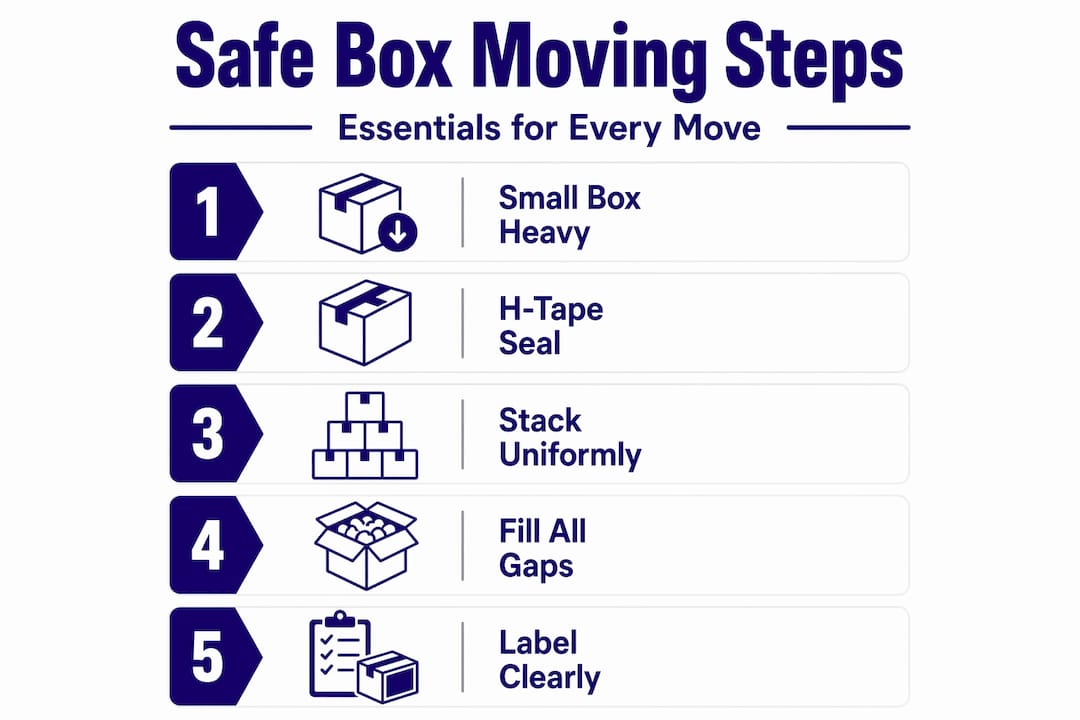
Pro Tip: Reinforce every box top and bottom using the H-pattern with packing tape. Proper box taping prevents box failure during stacking and lifting, which is especially important for boxes that will sit at the bottom of a heavy load.
Creating your essentials box
Your essentials box is arguably the most important box you pack. It should contain everything you need for moving day and your first night: phone chargers, toiletries, a change of clothes, basic kitchenware, medication, and important documents. Pack it last and load it last so it comes off the truck first. Label it clearly with “OPEN FIRST” in bold marker on all sides.
Step-by-step guide to loading pre-packed boxes
This is where your move either holds together or falls apart. The best way to move boxes safely relies on one core principle: loading in tiers, from heaviest to lightest, and securing each tier before building the next.
Follow these steps in order:
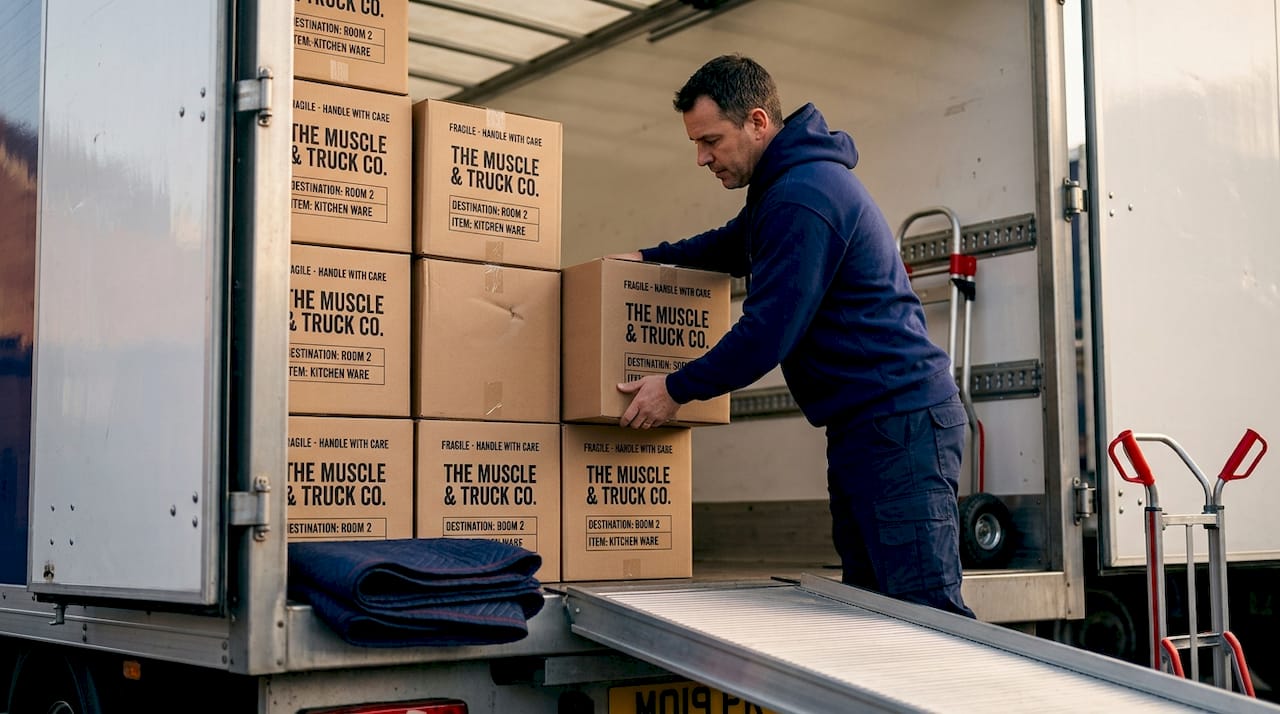
- Place your largest, heaviest furniture first. Items like wardrobes, bookshelves laid on their backs, sofas, and refrigerators go against the cab wall. Disassemble furniture where possible and wrap all pieces with furniture pads before loading.
- Stack your heaviest boxes directly on top of or beside heavy furniture. This forms your first tier. Heavy items and boxes create a sturdy foundation, preventing the load from shifting forward under braking.
- Fill every visible gap. Gaps between boxes and furniture allow items to move during transit, which is the primary cause of damage. Use rolled blankets, furniture pads, and even pillows to fill every space, including along the top of the first tier.
- Secure the first tier with rope or ratchet straps before moving on. Securing rows with tie-downs prevents multi-layer shifts and is the single most neglected step in DIY moves. Do not skip it.
- Build the next tier with medium-weight boxes. These sit on top of the heavy base. Keep weight consistent across the tier to maintain vehicle stability.
- Place lightest boxes on top. Bedding boxes, lampshades, and light items form the final layer. Never stack heavy boxes on light ones.
- Load your essentials box last and position it near the door for immediate access.
| Loading step | Purpose |
|---|---|
| Heaviest furniture first | Creates stable anchor for the entire load |
| Heavy boxes on base tier | Prevents forward and lateral shifting |
| Filling all gaps | Eliminates movement space during transit |
| Securing each tier | Stops multi-layer collapses on the road |
| Light boxes on top | Prevents crushing of fragile or lighter items |
Pro Tip: Clean wall loading means building solid vertical walls of boxes side by side before moving further into the truck. This creates stable structures and makes faster, safer DIY moves achievable without professional assistance.
Organising your packing and loading sequence
A well-organised loading sequence saves you enormous time when you unload at the other end. The logic is simple: the last room you pack should be the first room you unload. Most people do this backwards and pay for it later.
Here are the pre-packed moving strategies that make unpacking genuinely painless:
- Pack in reverse order of use. Start with rooms you use least, such as guest rooms, storage areas, and decorative items. End with the rooms you use daily: the kitchen, bathroom, and bedroom.
- Never mix rooms in a single box. It sounds obvious, but under time pressure, this rule gets broken constantly. A box labelled “Kitchen/Bedroom” helps no one during unpacking.
- Label on at least two sides. Labels on only the top become invisible once boxes are stacked. Write the room name and a brief content description on the side facing outward.
- Use colour-coded labels per room. One colour for the kitchen, another for the bedroom, another for the bathroom. This cuts unloading time significantly and allows helpers to direct boxes to the correct rooms at a glance.
- Declutter before you pack, not after. Every item you do not take is one less box to move. Be deliberate about what makes the journey.
If you are relocating a small business, this sequence planning is even more critical. Offices have mixed contents: electronics, files, furniture, and supplies. Group items by function or department and label boxes accordingly. Keeping server equipment and critical documents in a clearly marked, separately loaded section reduces the risk of loss or mishandling during the move.
For more practical preparation steps, the DIY moving checklist from The muscle and truck covers the full picture for first-time movers in Singapore.
Common mistakes that cause damage in transit
Even with good preparation, certain mistakes derail otherwise well-planned moves. Knowing what to avoid is half the battle.
Here are the most common errors and how to prevent them:
- Overpacking boxes until they bulge. A box should be filled completely but remain firm and manageable. Overpacked boxes collapse under the weight of stacked items above them, damaging both the box and its contents.
- Stacking heavy boxes on light ones. This crushes fragile items and destabilises the tier. Always work heaviest at the base and lightest at the top.
- Neglecting padding between boxes. Padding between boxes prevents abrasion and shifting, especially on longer journeys with multiple turns and stops. This step is frequently skipped and frequently regretted.
- Skipping the tie-down step. Many DIY movers assume a tightly packed truck does not need strapping. It does. Even a firmly loaded truck experiences movement during sharp turns and hard braking.
- Placing fragile items without clear marking. Wrap fragile items individually, place them in padded boxes, and mark all sides clearly. Do not bury them under heavy items.
Do a final walkthrough before you close the truck. Check that every gap is filled, every row is strapped, and your essentials box is accessible. Walk around the vehicle and look for anything that could shift or fall when you pull away.
Before you close the truck door, run through three quick checks: every gap filled, every tier strapped, and the essentials box positioned near the door. These three steps take under five minutes and prevent the majority of transit damage.
My honest take on moving with pre-packed boxes
I have seen dozens of moves play out, and the pattern is almost always the same. People spend real effort on packing and then treat the loading stage as an afterthought. They shove boxes in, close the door, and hope for the best.
The tiered loading method genuinely changes outcomes. When you start with a heavy, stable base and work upward in weight, the entire load behaves as a unit rather than as individual items fighting each other on every corner. The difference in how boxes arrive at the destination is noticeable.
The other misconception I encounter regularly is that a tight pack eliminates the need for tie-downs. It does not. Even boxes wedged in firmly have enough micro-movement over a 20-minute drive to cause real damage, especially to anything fragile or electronics-adjacent.
For small business moves, the organisation step matters more than people expect. I have seen office moves where a single unlabelled box caused hours of confusion because nobody could remember which department it came from. Colour-coding by department is not excessive. It is the one thing you will thank yourself for at 7pm when everyone is tired and just wants to finish.
The pre-packed moving guide from The muscle and truck covers additional strategies worth reading before moving day. And if fragile items or unusually shaped furniture are part of your load, communicate that clearly before transport so the right preparation is in place.
— Jessica
Moving your pre-packed boxes with Themuscleandtruck
If your boxes are packed and ready to go, the next step is getting reliable transport and muscle behind them.
Themuscleandtruck specialises in exactly this scenario: you have done your own packing, and you need a truck and capable hands to handle the lifting and transport. The service is priced by the hour with no hidden fees, making it a practical choice for individuals and small business owners who want control over costs. You can get an instant quote directly on the site and book quickly without back-and-forth. For additional guidance on moving without a packing service, the Themuscleandtruck blog has honest, practical resources tailored to Singapore movers.
FAQ
What is the best way to load pre-packed boxes onto a truck?
Load in tiers starting with the heaviest items and boxes at the base, then work upward with progressively lighter boxes. Secure each tier with rope or ratchet straps before stacking the next layer.
How do you prevent boxes from shifting during transport?
Fill every gap between boxes and furniture using blankets, pads, or pillows. Empty space is the main cause of shifting, so a fully packed load with secured rows moves far more safely.
Should heavy or light boxes go in first?
Heavy boxes always go in first, positioned at the bottom of each tier. Placing heavy boxes on top of lighter ones crushes the lower boxes and creates an unstable load.
How do I organise boxes for efficient unpacking?
Use colour-coded labels, one colour per room, and label at least two sides of every box. Pack the rooms you use daily last so those boxes come off the truck first at your destination.
What should go in an essentials box when moving?
An essentials box should hold everything you need on moving day and your first night, including chargers, toiletries, medication, documents, and basic kitchenware. Pack it last and load it nearest the truck door so it is the first thing you access.